
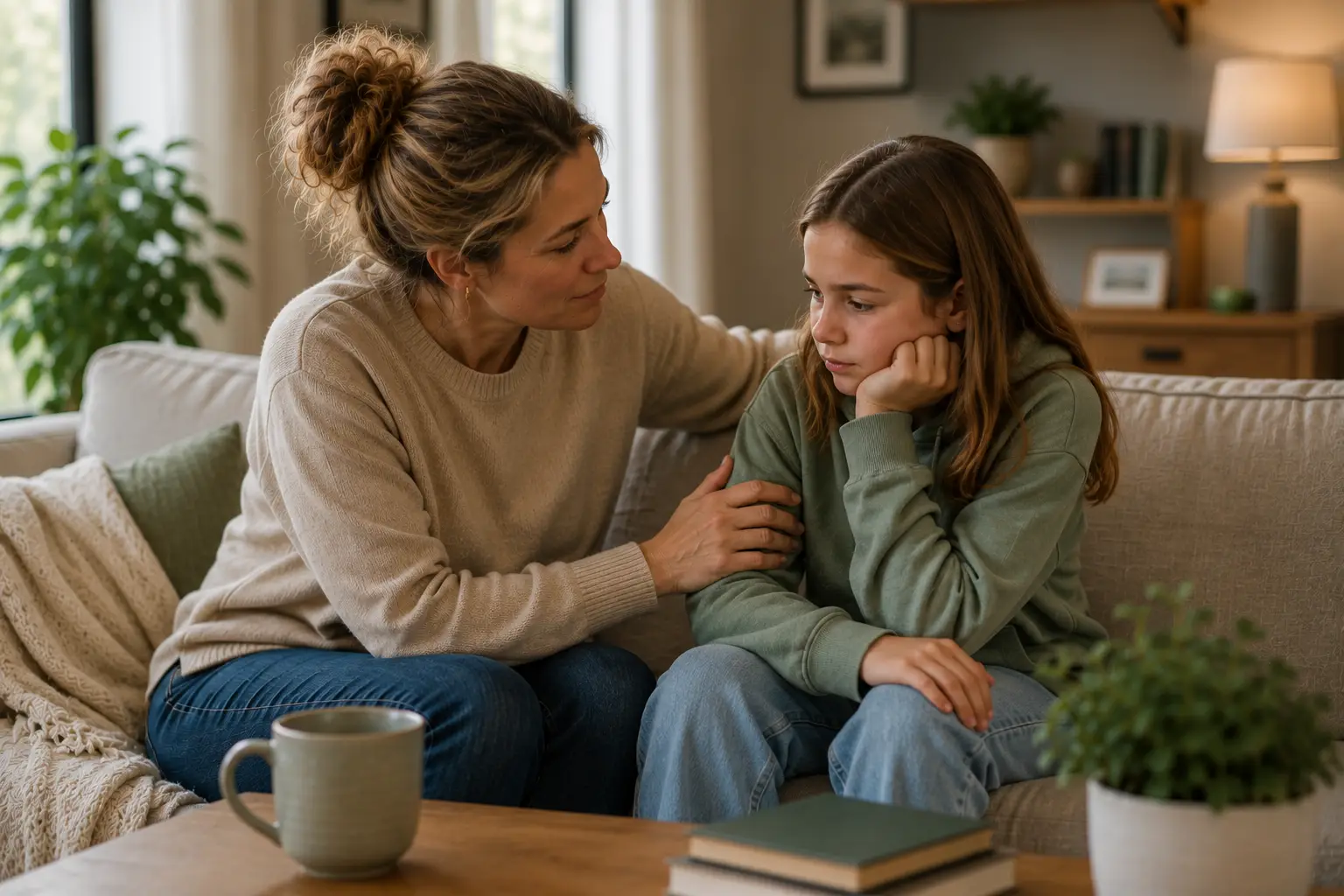
Helping children feel deeply without being controlled by what they feel
Big emotions are not the problem. Children need to learn how to notice, understand, and move through what they feel while staying connected and grounded.
You’ll receive a short reflection to help you get more out of the session.
Why This Matters More Than Most People Realize
Most parents want their children to learn how to handle emotions well.
Not just to:
And in those moments, children need more than instructions.
Not just to:
- calm down faster
- behave better
- avoid meltdowns
- stay grounded under pressure
- communicate honestly
- move through difficult emotions without being controlled by them
And in those moments, children need more than instructions.
They need an internal foundation.
What Most People Mean by “Handling Emotions”
When adults talk about children “handling emotions,” they often mean:
Children are not just learning:
- stopping the behavior
- calming down quickly
- becoming less reactive
- regaining control
Children are not just learning:
how to stop feeling.They are learning:
what emotions mean, what happens when emotions appear, and whether emotions are safe to experience in relationship.That changes the entire conversation.
Emotions Are Not the Problem
Many children quietly begin to believe:
But because emotional moments often create pressure:
- big emotions are bad
- sadness is weakness
- anger is dangerous
- fear should be hidden
- frustration means failure
But because emotional moments often create pressure:
- to fix
- to stop
- to control
- to move past the discomfort quickly
“Something is wrong with me when I feel this way.”But emotions themselves are not the problem.
Emotions are signals.They tell us something important is happening internally.
What Children Actually Need to Learn
Children do not need to learn:
And it is very different from emotional chaos.
It is:
“Never feel big emotions.”They need to learn:
- emotions can be noticed
- emotions can be understood
- emotions can move through us
- emotions do not have to control us
- emotions do not remove belonging or connection
And it is very different from emotional chaos.
It is:
emotional awareness with steadiness.
A Small Moment Most People Miss
A child is upset.
Maybe something didn’t go the way they hoped.
Maybe they’re frustrated.
Embarrassed.
Overwhelmed.
You can feel the tension rising in yourself too.
A pull:
You stay steady.
You help them notice what’s happening without becoming consumed by it.
And in that moment, they begin learning something deeper than “calming down.”
They begin learning:
Maybe something didn’t go the way they hoped.
Maybe they’re frustrated.
Embarrassed.
Overwhelmed.
You can feel the tension rising in yourself too.
A pull:
- to calm them down quickly
- to explain
- to correct
- to make the emotion stop
You stay steady.
You help them notice what’s happening without becoming consumed by it.
And in that moment, they begin learning something deeper than “calming down.”
They begin learning:
“I can feel something strongly… and still remain safe, connected, and okay.”That matters more than most people realize.
Why Emotional Moments Feel So Big for Parents Too
Children’s emotions often affect parents emotionally.
Especially when:
They are also responding to:
Not because anyone is bad.
But because:
Especially when:
- emotions escalate quickly
- voices get louder
- conflict begins to form
- behavior becomes disrespectful
- tension fills the room
They are also responding to:
- their own stress
- their own overwhelm
- their own emotional patterns
- their own fear about what the moment means
Not because anyone is bad.
But because:
two inner worlds are interacting at the same time.
Teaching Emotional Awareness Instead of Emotional Fear
Children learn emotional safety largely through experience.
Not lectures.
Not perfect parenting.
Experience.
They begin learning:
Boundaries still matter.
Responsibility still matter.
But children also need to experience:
Not lectures.
Not perfect parenting.
Experience.
They begin learning:
- what emotions mean
- how emotions are handled
- whether emotions threaten connection
- whether they are still accepted while struggling
Boundaries still matter.
Responsibility still matter.
But children also need to experience:
steady connection while emotions are present.That combination helps emotional maturity grow over time.
Another Real Moment
A teenager says something sharp in frustration.
You can feel it immediately:
You pause.
You respond with steadiness instead of escalation.
And the conversation doesn’t spiral the same way it might have in the past.
Not because the emotion disappeared.
But because:
You can feel it immediately:
- tightness
- urgency
- the pull to react
- shut the conversation down
- become more forceful
- prove a point
You pause.
You respond with steadiness instead of escalation.
And the conversation doesn’t spiral the same way it might have in the past.
Not because the emotion disappeared.
But because:
someone remained grounded inside the moment.
Emotional Strength Is Not Emotional Suppression
Some children learn to hide emotions well.
They appear:
They appear:
- calm
- composed
- mature
- anxious
- disconnected
- emotionally alone
never feeling deeply.It is:
being able to feel deeply without losing yourself inside the feeling.That is what emotional awareness begins to create.
What Helps Children Over Time
Children grow emotionally through repeated experiences of:
But gradually.
- noticing emotions
- naming emotions
- staying connected during emotions
- learning that emotions are temporary
- experiencing steadiness from trusted adults
- self-awareness
- emotional regulation
- resilience
- honesty
- relational safety
But gradually.
What Children Need Most in Big Emotional Moments
Children do not need:
- perfect parents
- constant fixing
- emotional overprotection
- stay grounded
- notice what’s happening internally
- create steadiness in difficult moments
- hold both boundaries and connection together
“My emotions matter… but they do not control who I am.”
Where This Begins
Most parents are already trying to navigate this.
You can feel it in moments like:
And often, the answer begins before the words themselves.
It begins with:
You can feel it in moments like:
- “How do I help without escalating?”
- “How do I stay calm when emotions get big?”
- “How do I teach emotional regulation without shame?”
And often, the answer begins before the words themselves.
It begins with:
- awareness
- steadiness
- noticing what is happening internally
- creating space before reacting
Join the Unlock™ Workshop
In the Unlock™ Workshop, we walk through:
- why reactions happen in real moments
- how emotional patterns shape conversations
- how awareness creates space for different responses
- how steadiness and connection can grow together
This is where awareness begins to create a different way forward.
You’ll receive a short reflection to help you get more out of the session.
Continue Exploring
If this resonated, these related pieces may help you keep going: