
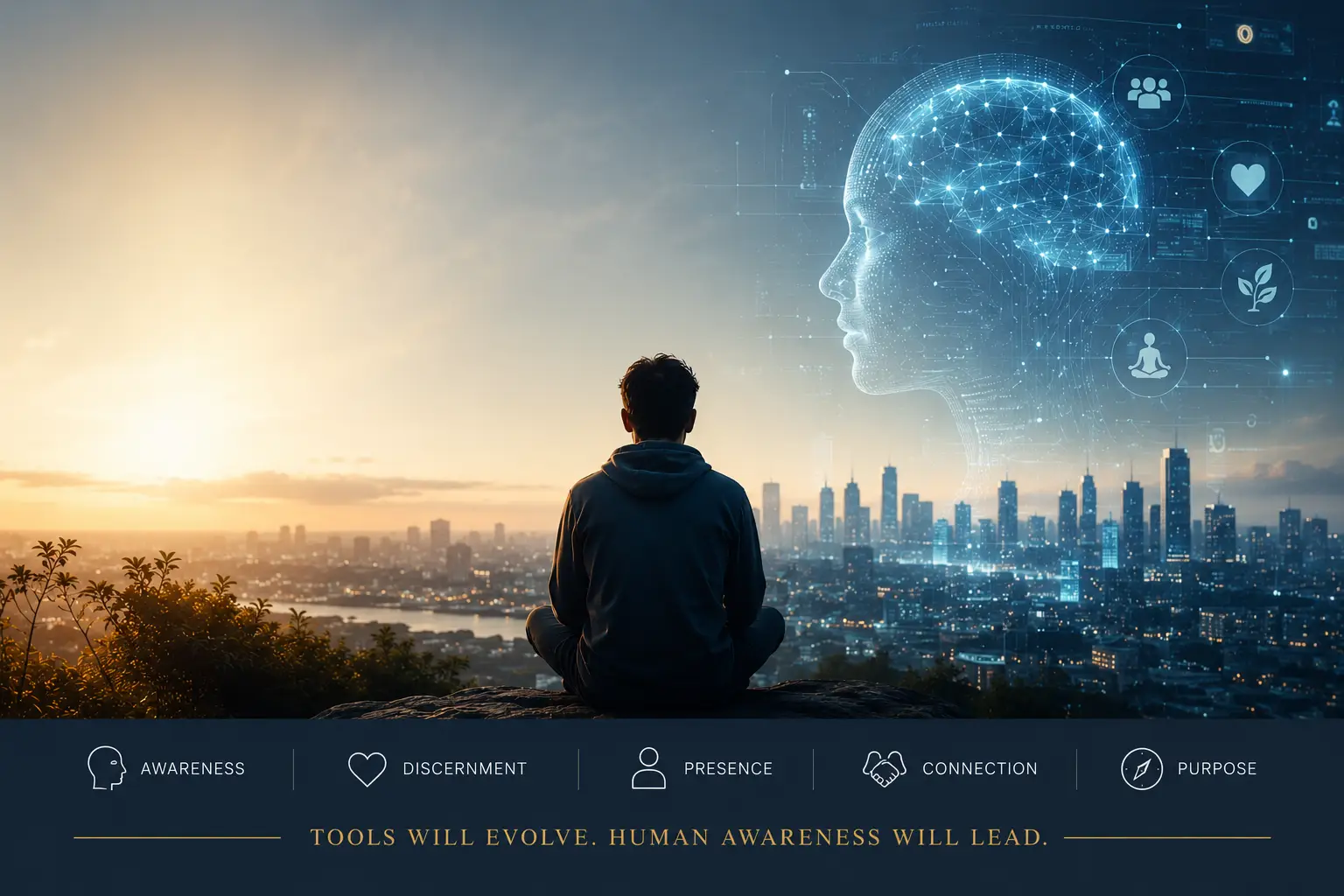
As artificial intelligence expands what we can know and create, the deeper question becomes what kind of humans we are becoming.
As external intelligence expands, internal awareness becomes more valuable.
This is the heart of the conversation — and one of the clearest ways Flourish First can speak into the age of AI without becoming another voice in the noise.
AI may change what we can access, produce, and automate. But it does not remove the deeper human question: Who are we becoming as we use it?
We are entering a world where information is becoming nearly free.
Ideas. Strategies. Frameworks. Answers. Content. Coaching prompts. Even emotional language.
Artificial intelligence can now generate all of it in seconds.
And yet something important is becoming increasingly clear:
Knowing is not the same as becoming.
That matters more than ever.
Knowing is not the same as becoming. Information can be generated. Awareness must be practiced.
Most People Already Know More Than They Live
Most people already know more than they live.
They know they should communicate better, be more patient, stop reacting defensively, set healthier boundaries, stay calm under pressure, have the difficult conversation, and spend more meaningful time with people they love.
But in real life — especially in emotional moments — something else often takes over.
A tightening in the chest. A defensive impulse. A familiar pattern. A need to protect. A fear of rejection. A rush to explain, control, withdraw, or shut down.
It may look like a leader walking into a meeting already braced before a single word is spoken. Or a parent sitting in the car after a tense conversation, replaying what they wish they had said differently.
And it often happens before conscious thought fully arrives.
That is where human awareness becomes essential.
Not awareness as information. Awareness as presence.
The ability to notice what is happening inside us while it is happening.
Because transformation has never been primarily an information problem.
It is an awareness problem.
What AI Can Do — and What It Cannot Do For Us
AI can provide extraordinary tools.
It can help us organize knowledge, accelerate learning, improve efficiency, generate possibilities, increase access to education, support creativity, and clarify communication.
But AI cannot become aware for us.
It cannot feel the subtle shift happening inside a human conversation.
It cannot fully discern the difference between speaking from fear and speaking from clarity, reacting and responding, control and connection, performance and authenticity, information and wisdom.
Those moments still belong to us.
And in many ways, they are becoming more important — not less.
AI may help us form words. It cannot choose the inner place those words come from.
The Paradox of the AI Age
The paradox of the AI age may be this:
As external intelligence expands, internal awareness becomes more valuable.
Because when everyone has access to answers, the differentiator becomes discernment, emotional steadiness, relational depth, integrity, self-awareness, wisdom, presence, and the ability to remain human under pressure.
The future may not belong to the people who simply know the most.
It may belong to the people who can stay grounded in complexity, recognize what is happening inside themselves, respond intentionally, build trust, create belonging, and use powerful tools without losing their humanity.
The Question Technology Cannot Answer For Us
This is not anti-AI.
In many ways, AI may become one of the greatest amplifiers humanity has ever created.
But amplification always raises another question:
What exactly is being amplified?
If we are reactive, distracted, disconnected, and unaware — technology can magnify that.
If we are grounded, aware, thoughtful, and connected — technology can magnify that too.
The tool matters.
But the inner condition of the person using the tool matters more.
Efficiency Is Not the Same as Flourishing
There is also something deeper happening beneath all of this.
Many people are quietly discovering that achievement alone does not create flourishing.
Efficiency does not automatically create peace.
Optimization does not guarantee meaning.
Speed does not produce connection.
And endless access to information does not necessarily help us understand ourselves.
In fact, the more noise surrounding us, the more valuable inner clarity becomes.
That is why practices like reflection, emotional awareness, discernment, spirituality, stillness, presence, and meaningful human connection may become increasingly essential in the years ahead.
Not because technology is bad.
But because human beings were never meant to function as machines.
The future will not only be shaped by artificial intelligence. It will be shaped by the awareness of the humans using it.
The Real Opportunity of the AI Era
The real opportunity of the AI era may not simply be building smarter systems.
It may be becoming more fully human.
More aware. More intentional. More discerning. More connected. More capable of responding rather than merely reacting.
Because the future will not only be shaped by artificial intelligence.
It will also be shaped by the level of awareness of the humans using it.
And that may become one of the most important conversations of our time.
A gentle reflection before you go
Where are you most tempted to move faster right now — when what you may actually need is more awareness?
Not more information. Not another strategy. Not another tool.
Just enough space to notice what is happening inside you before the next response takes shape.
That space is where choice begins.
If this is the kind of awareness you want to build, Unlock™ Level 1 was created to help you begin there — with calm, guided practices that help you understand who you are, notice what is happening within you, and respond in ways that feel more aligned with who you are becoming.