

Building Relationships That Lead To Belonging
You’re sitting in a room full of people.
The conversation is flowing.
Everyone seems comfortable.
Everyone seems connected.
You smile.
You participate.
You say the right things.
Yet somewhere beneath the surface, something feels missing.
You don’t feel fully known.
You don’t feel fully understood.
You don’t feel entirely yourself.
Or perhaps you’ve experienced the opposite.
A conversation with a trusted friend.
A spouse.
A parent.
A child.
A moment where you didn’t need to perform.
Didn’t need to impress.
Didn’t need to hide.
You felt seen.
Valued.
Accepted.
Safe.
For a moment, you felt like you belonged.
Most people know the difference.
And most people spend much of their lives searching for more of the second experience.
The Hidden Tension
We live in one of the most connected times in human history.
Communication is constant.
Messages arrive instantly.
Social networks connect billions of people.
Technology allows us to interact across the world.
Yet loneliness continues to grow.
Many people find themselves surrounded by communication while longing for connection.
Because communication and connection are not the same thing.
Interaction is not the same thing as relationship.
Being around people is not the same thing as belonging.
The world has made communication easier than ever.
It has not necessarily made connection easier.
And it has certainly not guaranteed belonging.
Human flourishing requires something deeper.
Connection
Connection is the ability to build meaningful relationships characterized by trust, understanding, empathy, authenticity, and emotional safety.
Connection allows us to know others and be known by them.
It creates the conditions for belonging.
Connection is not simply proximity.
It is not communication alone.
It is not social interaction.
It is the quality of relationship that develops when people are willing to understand, trust, and genuinely engage with one another.
Strong relationships do not happen automatically.
They are cultivated intentionally.
And they become one of the most important foundations of human flourishing.
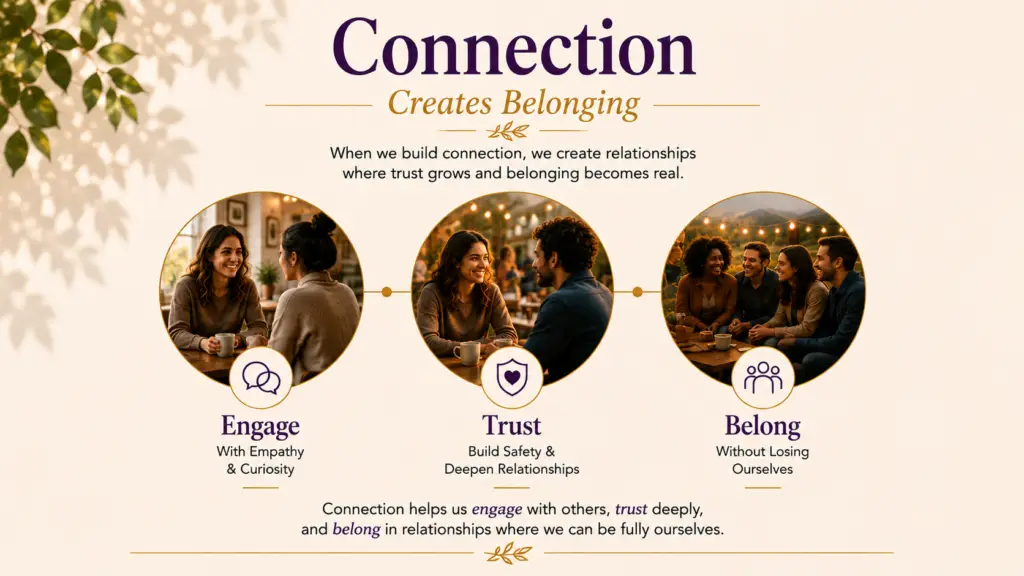
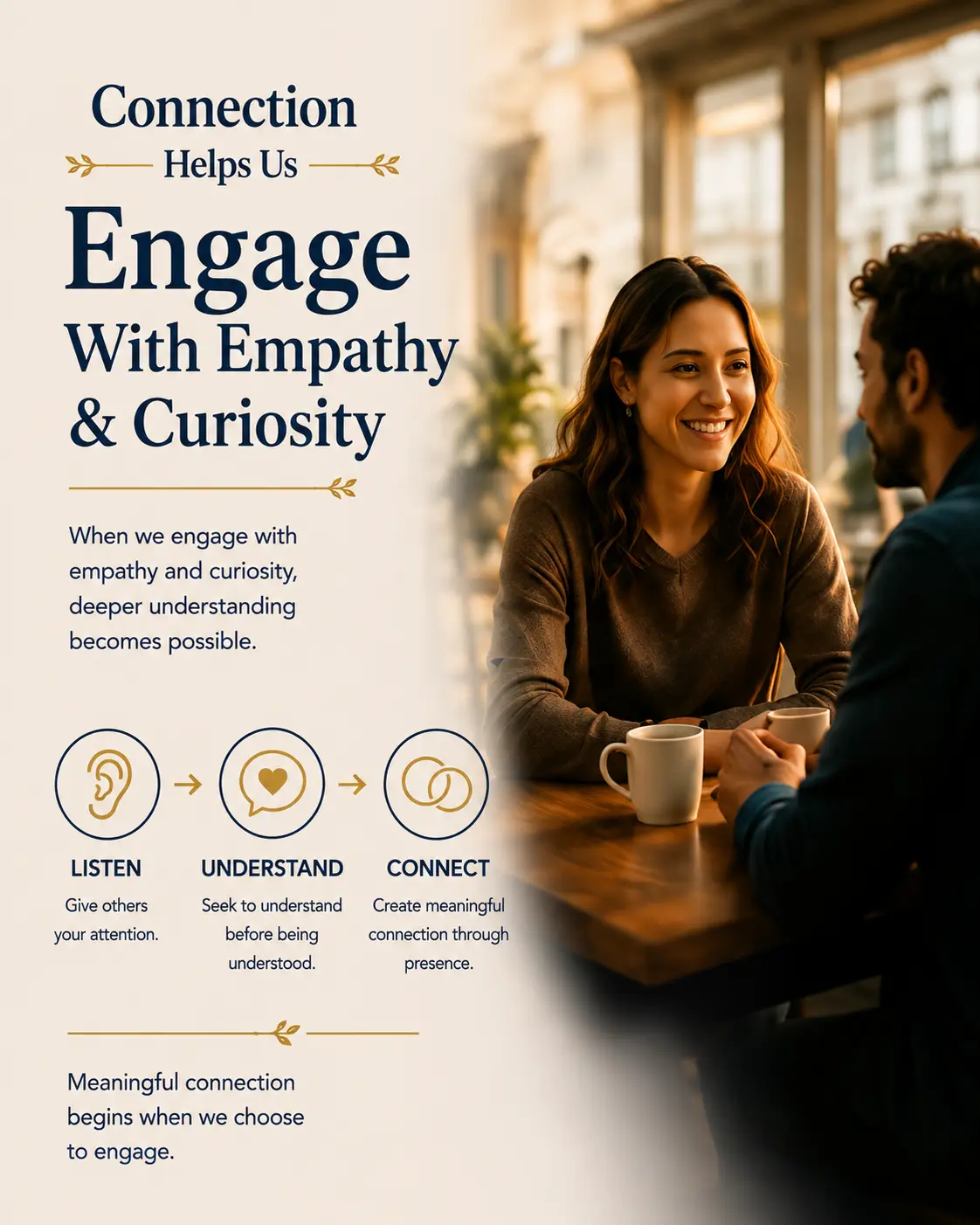
Connection Helps Us Engage With Empathy & Curiosity
Connection begins long before trust is established or belonging is experienced.
It begins in the moments when we choose to genuinely engage with another person. Every meaningful relationship—whether with a spouse, child, friend, coworker, or neighbor—starts with a willingness to move beyond assumptions and become present to another human being.
Many relationship challenges are not caused by a lack of caring. They arise because we stop engaging. We become distracted, defensive, rushed, or focused on being understood rather than understanding. Empathy and curiosity create a different possibility. They help us move from judgment to understanding and from distance to connection.
This matters because healthy relationships are built not merely on communication, but on the quality of attention we bring to one another.
Listen
Listening is more than hearing words.
To listen is to offer another person your attention. It is the decision to be present enough to notice not only what is being said, but what may be felt, feared, hoped for, or needed beneath the surface. Listening communicates value because it says, “You matter enough for me to pause and pay attention.” Without listening, connection struggles to take root because people rarely feel understood when they do not feel heard.
Understand
Understanding grows when curiosity becomes stronger than certainty.
To understand is to seek perspective before judgment. Rather than assuming we already know another person’s motives, intentions, or experiences, we remain open to learning more. Understanding does not require agreement. It requires a willingness to recognize that another person’s experience may be different from our own. When understanding deepens, defensiveness often softens and space for genuine connection begins to emerge.
Connect
Connection is the result of presence expressed over time.
To connect means creating meaningful relational bonds through attention, empathy, and engagement. Connection is not simply proximity or frequent interaction. It is the experience of being seen, known, and valued. When people feel connected, trust grows more naturally, communication becomes more productive, and relationships become more resilient. Connection transforms interactions into relationships and relationships into communities of support and belonging.
Bringing It Together
Listen, Understand, and Connect work together to create the foundation for healthy relationships.
Listening helps us become present. Understanding helps us move beyond assumptions. Connection emerges as a natural result of consistently engaging with empathy and curiosity. Together, these actions create an environment where people feel safe enough to be known and valued for who they are.
This is why Connection Helps Us Engage With Empathy & Curiosity.
Meaningful connection rarely happens by accident. It grows through intentional attention, genuine curiosity, and a willingness to understand before seeking to be understood. As we learn to listen, understand, and connect, we create the conditions in which trust, belonging, and deeper relationships can flourish.
Connection Helps Us Trust to Build Safety & Deepen Relationships
Trust is one of the most important elements of healthy relationships, yet it is often misunderstood.
Many people think trust is something that simply exists or does not exist. In reality, trust is built over time through countless small moments. It grows through consistency, honesty, respect, and the willingness to show up authentically with one another.
Whether in families, friendships, marriages, workplaces, or communities, trust creates the emotional safety that allows relationships to deepen. Without trust, people often protect themselves, hide parts of who they are, or remain guarded. With trust, people become more willing to be known, understood, and connected.
This matters because meaningful belonging cannot be forced. It emerges when people feel safe enough to bring their authentic selves into a relationship.
Open
Trust begins with openness.
To open is to choose appropriate vulnerability. It is the willingness to let others see parts of our thoughts, feelings, experiences, and needs that we might otherwise keep hidden. Openness is not about sharing everything with everyone. It is about wisely allowing ourselves to be seen where trust is being built. When we open appropriately, we create opportunities for authenticity, understanding, and deeper connection.
Share
Sharing transforms openness into relationship.
To share means communicating honestly and respectfully about our experiences, perspectives, and needs. Healthy sharing creates clarity and reduces the distance that assumptions often create between people. It allows others to understand us more accurately while also inviting mutual understanding. Sharing strengthens trust because it demonstrates honesty, respect, and a willingness to engage rather than withdraw.
Deepen
Trust becomes stronger through consistency.
To deepen is to build reliability through repeated actions over time. While words matter, trust ultimately grows when our actions consistently align with what we communicate. Reliability creates predictability, and predictability creates safety. As people experience honesty, follow-through, and integrity repeatedly, trust moves beyond hopeful possibility and becomes a stable foundation for the relationship.
Bringing It Together
Open, Share, and Deepen work together to create the conditions where trust can flourish.
Openness allows us to be seen. Sharing allows us to be understood. Deepening transforms those experiences into lasting confidence through consistent action. Together, these three practices help relationships move beyond surface interaction toward genuine safety and connection.
This is why Connection Helps Us Trust to Build Safety and Deepen Relationships.
Trust is rarely built through one grand gesture. More often, it grows through small moments of honesty, vulnerability, consistency, and care. As trust grows, relationships become safer places to learn, grow, and belong. And where trust is present, deeper connection becomes possible.
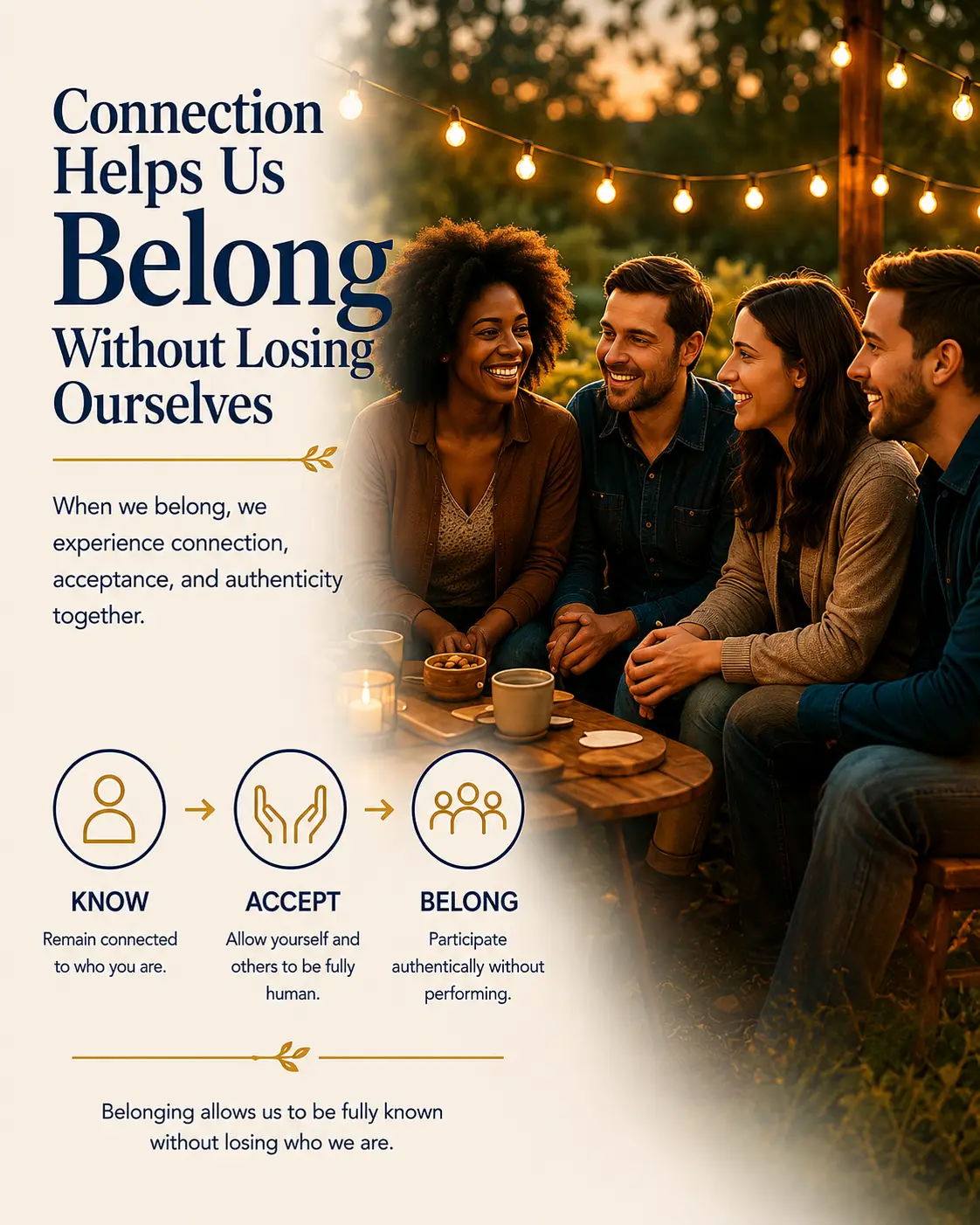
Connection Helps Us Belong Without Losing Ourselves
Belonging is one of the deepest human needs. We all want to feel accepted, valued, included, and connected. Yet many people have experienced a version of belonging that came with an unspoken condition: fit in, perform, or become what others expect.
As a result, many people find themselves caught between two desires. They want connection, but they also want to remain true to who they are. They want acceptance without pretending. They want community without losing their identity.
Healthy belonging is different. It is not the loss of self for the sake of connection. It is the ability to remain connected to who you are while participating meaningfully with others. True belonging allows both individuality and connection to exist together.
Know
Belonging begins with self-awareness.
To know is to remain connected to who you are—your values, needs, experiences, strengths, and convictions. When we lose sight of ourselves, we often begin looking to others to define our worth or identity. Knowing who we are creates an internal anchor that allows us to engage in relationships without becoming dependent on approval. The stronger our connection to ourselves, the more freely we can connect with others.
Accept
Acceptance creates the emotional space where belonging can grow.
To accept is to allow yourself and others to be fully human. It means recognizing that people are imperfect, still growing, and worthy of dignity even when they struggle. Acceptance is not agreement with every behavior or abandoning healthy boundaries. Rather, it is choosing compassion over judgment and understanding over condemnation. Acceptance creates safety, and safety is one of the foundations of belonging.
Belong
Belonging emerges when we participate authentically.
To belong means showing up as ourselves rather than performing a role, hiding parts of who we are, or constantly trying to earn acceptance. Authentic participation allows relationships to move beyond appearance and into genuine connection. Belonging is not something we manufacture through performance. It develops when people can be seen, known, and valued without pretending to be someone they are not.
Bringing It Together
Know, Accept, and Belong work together to create meaningful connection without sacrificing identity.
Knowing helps us stay grounded in who we are. Acceptance creates the safety necessary for authenticity. Belonging becomes possible when we bring our genuine selves into relationships and communities. Together, these practices help us experience connection without losing ourselves in the process.
This is why Connection Helps Us Belong Without Losing Ourselves.
Many people spend years trying to choose between authenticity and acceptance. Healthy belonging invites a different possibility. It reminds us that we do not have to abandon who we are in order to be connected. As we grow in self-awareness, practice acceptance, and participate authentically, we create relationships where both connection and individuality can flourish side by side.
Why Connection Matters
Human beings are relational by nature.
From the moment we enter the world, relationships influence:
- our identity
- our beliefs
- our sense of worth
- our sense of safety
- our understanding of belonging
The quality of our relationships often shapes the quality of our lives.
Strong connection contributes to flourishing.
Disconnection often contributes to loneliness, anxiety, conflict, isolation, and suffering.
The need for connection is not weakness.
It is part of what makes us human.
The Invitation
Human flourishing grows through four interconnected capacities:
Seeing ourselves, our experiences, and our choices more clearly.
Living in alignment with who we are.
Building relationships that lead to belonging.
Living with meaning, contribution, and influence.
Awareness helps us see clearly.
Self-Competence helps us live consistently.
Connection helps us belong deeply.
Purpose helps us contribute meaningfully.
Human flourishing grows when all four capacities develop together.