

Living In Alignment With Who You Are
You’re driving home after a difficult conversation.
Part of you knows you didn’t show up the way you wanted to.
Maybe you reacted. Maybe you became defensive. Maybe you said something you wish you could take back.
Or perhaps you stayed silent when you wanted to speak.
The conversation is over. But it keeps replaying in your mind.
You know what you wish you had done. You know what you wish you had said. You know the person you want to be.
The question is: Why didn’t I show up that way?
Most people have experienced moments like this. Moments when our actions don’t fully reflect our values. Moments when we know what matters, yet struggle to live it.
Moments when we find ourselves asking: Why do I keep doing this? Why do I react this way? Why is it so hard to be who I want to be?
The Hidden Tension
Many people assume the problem is knowledge.
If we know better, we’ll do better. If we know how to communicate, we’ll communicate well. If we know how to stay calm, we’ll stay calm. If we know our values, we’ll naturally live by them.
Yet life often tells a different story.
We know. And still we struggle.
We know the parent we want to be. The partner. The leader. The friend.
Yet when emotions rise, pressure builds, or circumstances become difficult, we often find ourselves acting against what we know.
The challenge is not always awareness. Sometimes the challenge is alignment.
Knowing who we are and consistently living from that place are not always the same thing.
Human flourishing requires more than insight. It requires the ability to live what we know.
Self-Competence
Self-Competence is the capacity to know who you are and act in alignment with who you are.
It is the ability to remain grounded in your values, intentional in your choices, and responsible in your responses regardless of circumstances.
Self-Competence is not perfection. It is not certainty. It is not always feeling confident.
It is the growing ability to:
- Respond rather than react.
- Live according to your values.
- Take responsibility for your choices.
- Remain open to learning.
- Recover from mistakes.
- Adapt when circumstances change.
- Continue moving forward with integrity.
Awareness helps us know who we are.
Self-Competence helps us live in alignment with who we are.
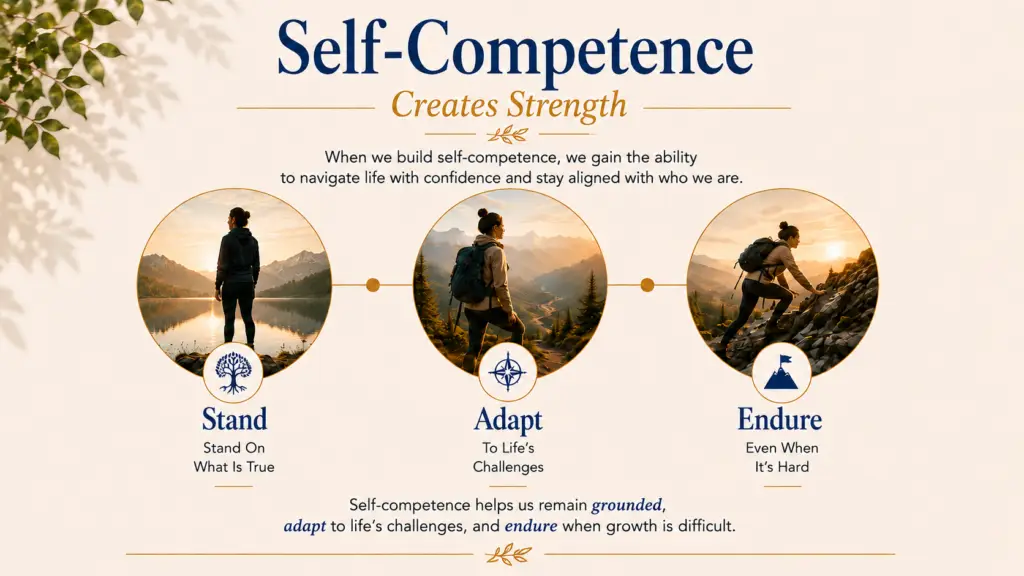
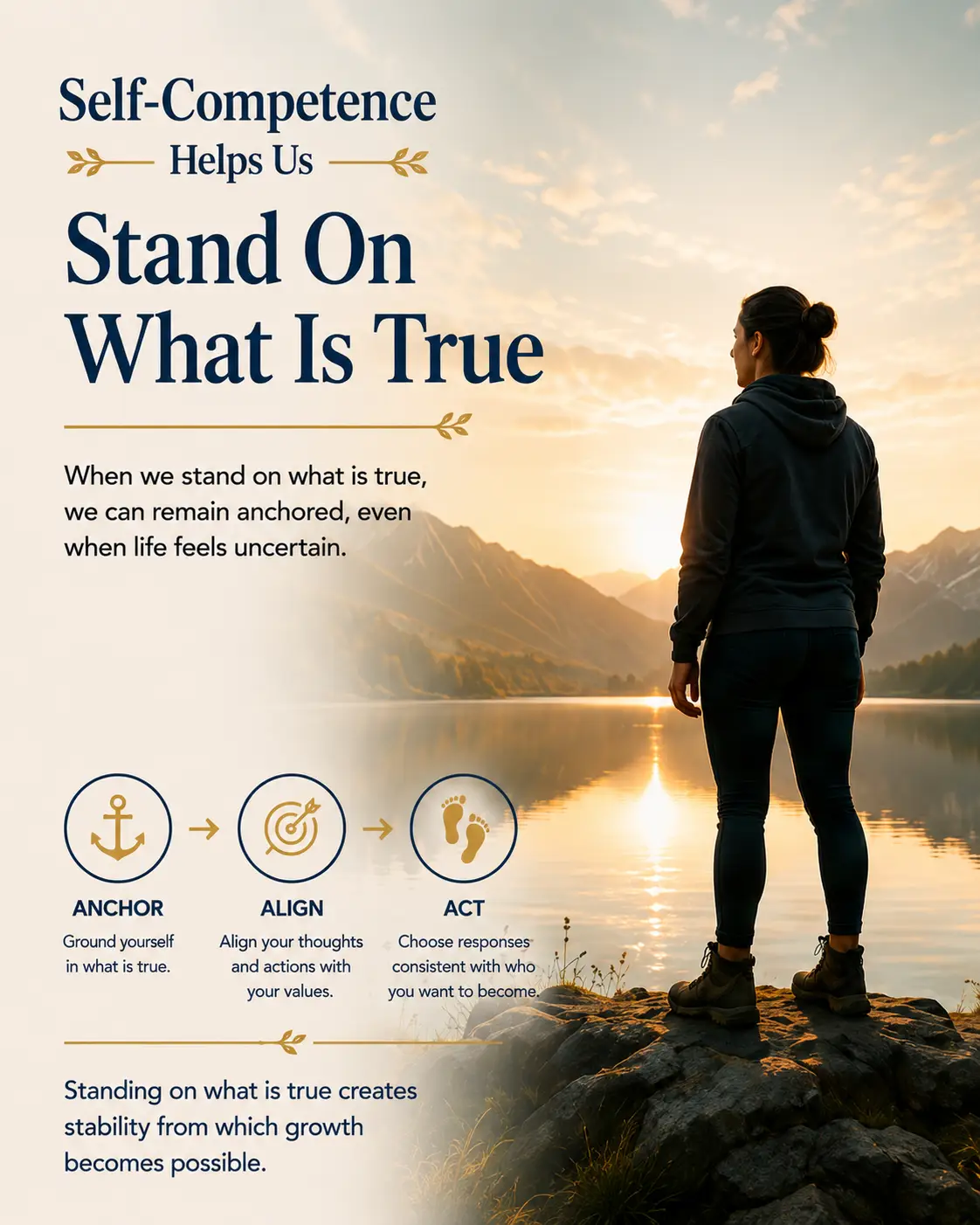
Self-Competence Helps Us Stand On What Is True
Self-competence begins with a simple but powerful question: What remains true when circumstances change?
Life is full of uncertainty. Expectations shift. Relationships change. Challenges emerge. In those moments, it is easy to become reactive, overwhelmed, or disconnected from ourselves. We may find ourselves making decisions based on fear, pressure, or the opinions of others rather than from a place of clarity.
Standing on what is true creates stability in the midst of change. It helps us remain grounded in our values, identity, and deeper convictions rather than being pulled in every direction by external circumstances. Before we can adapt, persevere, or lead ourselves well, we need something solid on which to stand.
Anchor
Anchor is the practice of grounding yourself in what is true.
Truth in this context is not merely information. It includes the values, principles, and beliefs that provide direction and meaning in your life. Anchoring helps create an internal reference point when emotions are strong or circumstances are uncertain. Rather than being controlled by the moment, we are able to return to what we know matters most. An anchored life provides steadiness when everything around us feels unsettled.
Align
Knowing what is true is important, but self-competence grows when our lives begin to reflect that truth.
Align means bringing our thoughts, choices, and actions into greater harmony with our values and identity. Many of the tensions we experience come from the gap between what we believe and how we live. Alignment helps reduce that gap. It creates integrity between our inner world and our outward actions. As alignment increases, so does our sense of clarity, confidence, and peace.
Act
Truth and alignment ultimately invite movement.
Act means choosing responses that reflect who we want to become rather than simply reacting to what is happening around us. Action transforms beliefs into lived experience. It is where values become visible and character begins to take shape. While circumstances may not always be within our control, our response remains one of the most powerful expressions of who we are.
Bringing It Together
Anchor, Align, and Act work together to create a foundation for self-competence.
Anchor helps us identify what is true. Align helps us bring our lives into greater harmony with that truth. Act allows us to express those values through intentional choices and consistent behavior. Together, they move truth from an abstract idea into a lived reality.
This is why Self-Competence Helps Us Stand On What Is True.
When we know what we stand for, align our lives accordingly, and act with intention, we develop the stability needed to navigate life’s challenges with greater confidence and purpose. The invitation is not to become perfect. It is to become increasingly grounded in what is true and allow that truth to guide the person you are becoming.
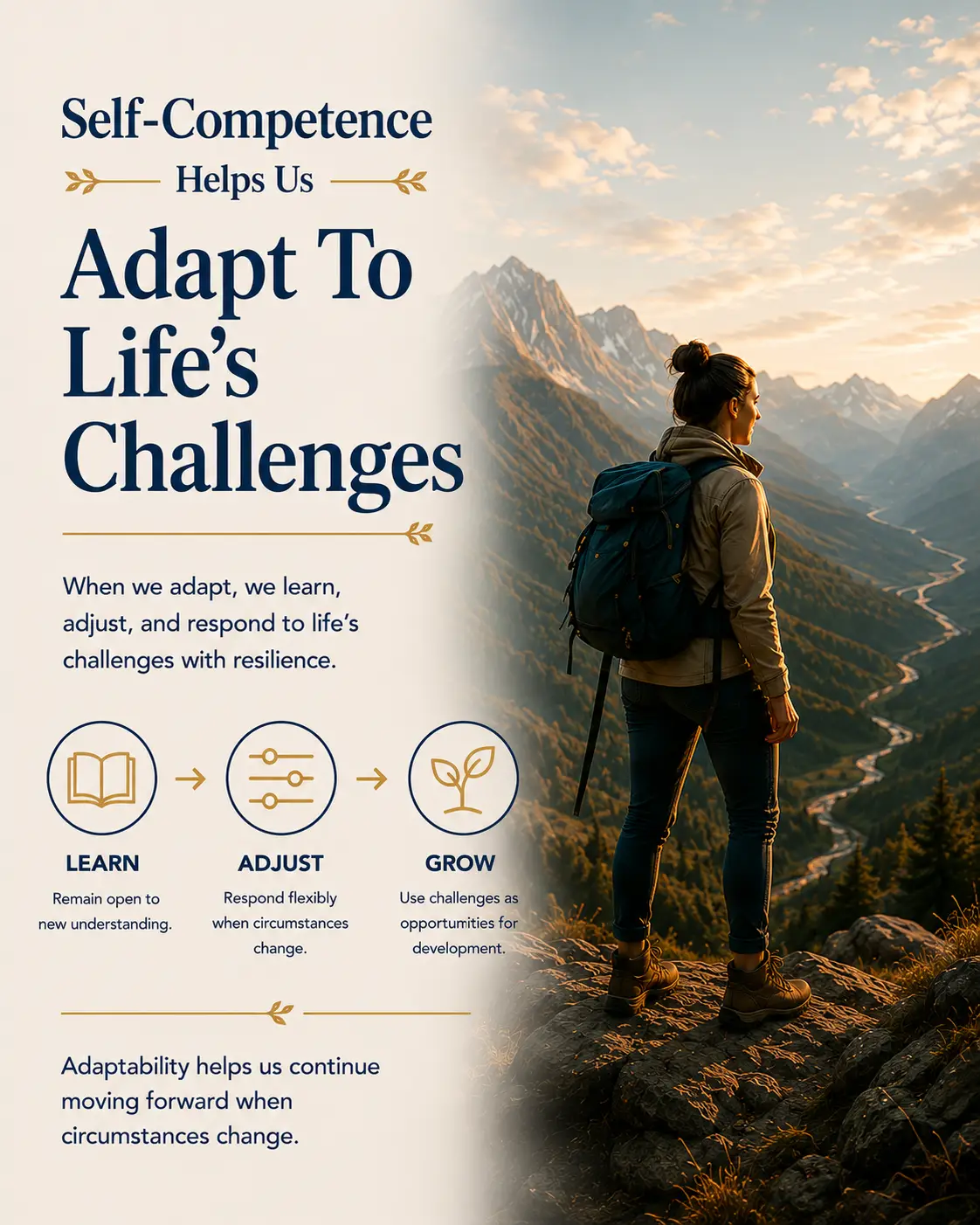
Self-Competence Helps Us Adapt To Life’s Challenges
Life rarely unfolds exactly as we expect.
Plans change. Relationships evolve. Opportunities appear unexpectedly, and difficulties often arrive without invitation. While we cannot control every circumstance we encounter, we can develop the capacity to respond in ways that help us continue moving forward.
Self-competence is not simply about standing firm. It is also about remaining flexible. Adaptability allows us to navigate change without losing ourselves. Rather than becoming stuck, discouraged, or overwhelmed by life’s challenges, we learn to adjust while remaining grounded in what matters most.
This ability is essential because growth rarely happens in perfect conditions. More often, growth emerges through learning, adjusting, and developing through the very challenges we face.
Learn
Adaptability begins with a willingness to learn.
Learning means remaining open to new information, new perspectives, and new understanding. It requires humility—the recognition that there may be more to see, understand, or consider. When we stop learning, we often become rigid. When we remain curious, new possibilities become available. Learning helps us move beyond old assumptions and equips us to respond more effectively to changing circumstances.
Adjust
Learning creates awareness, but adaptability requires adjustment.
Adjust means responding flexibly when circumstances change. It does not mean abandoning our values or compromising who we are. Rather, it means recognizing that the same approach may not work in every situation. Adjustment allows us to remain responsive instead of reactive. It helps us adapt our strategies, expectations, and behaviors while staying anchored in what is true.
Grow
Growth is often the outcome of learning and adjustment.
Grow means viewing challenges not merely as obstacles, but as opportunities for development. Difficult experiences can strengthen wisdom, resilience, patience, and character when we are willing to engage with them intentionally. Growth does not require us to enjoy every challenge we face. It invites us to recognize that even difficult experiences can contribute to who we are becoming.
Bringing It Together
Learn, Adjust, and Grow work together to create adaptability.
Learning helps us see new possibilities. Adjustment helps us respond wisely to changing circumstances. Growth allows us to integrate those experiences into greater capability, resilience, and maturity. Together, these three practices help us continue moving forward even when life does not unfold according to plan.
This is why Self-Competence Helps Us Adapt To Life’s Challenges.
Adaptability is not about becoming someone different every time circumstances change. It is about remaining open, responsive, and grounded as life unfolds. When we learn, adjust, and grow, challenges become more than interruptions to our journey. They become part of the process through which strength, wisdom, and self-competence are developed.
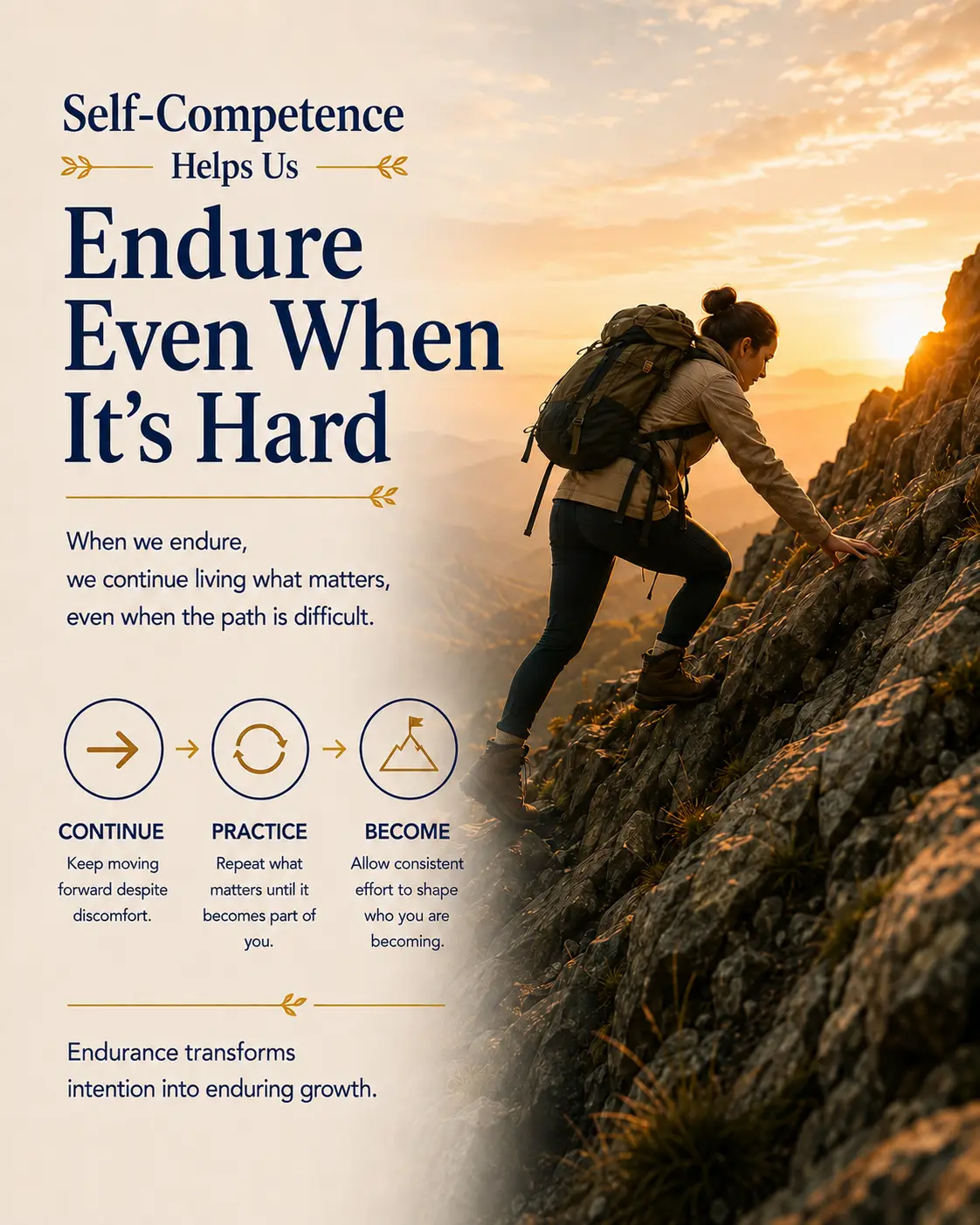
Self-Competence Helps Us Endure Even When It’s Hard
Growth rarely happens because life becomes easy.
More often, growth happens because we continue moving forward when the path becomes difficult. Challenges, setbacks, uncertainty, and discomfort are part of every meaningful journey. Whether we are strengthening relationships, developing new skills, pursuing a purpose, or becoming a better version of ourselves, there will be moments when quitting feels easier than continuing.
Self-competence includes the ability to remain committed to what matters, even when motivation fades or progress feels slow. Perseverance is not about forcing ourselves through life with sheer willpower. It is about developing the capacity to continue living in alignment with our values despite obstacles and resistance.
This matters because the person we become is often shaped less by our intentions and more by what we consistently practice over time.
Continue
Endure begins with the decision to continue.
Continue means choosing to keep moving forward even when the next step feels difficult. It is not about never struggling or never feeling discouraged. It is about refusing to allow temporary discomfort to determine the direction of our lives. Continuing builds resilience because it teaches us that difficulty does not necessarily mean we are on the wrong path. Sometimes it simply means we are growing.
Practice
Growth is strengthened through repetition.
Practice means returning again and again to the behaviors, habits, and principles that support the person we want to become. Most meaningful change does not happen through a single breakthrough moment. It happens through repeated choices made consistently over time. Practice transforms ideas into habits, values into behaviors, and intentions into lived experience. Through repetition, what once required effort gradually becomes part of who we are.
Become
Perseverance ultimately shapes identity.
Become recognizes that every choice contributes to the person we are becoming. As we continue and practice what matters, growth begins to move beyond what we do and into who we are. Character is formed through consistent effort. Confidence grows through repeated experience. Becoming is the long-term result of living intentionally enough that our actions and identity gradually come into alignment.
Bringing It Together
Continue, Practice, and Become work together to transform effort into growth.
Continue helps us move forward when challenges arise. Practice helps us strengthen what matters through repetition. Become reminds us that every intentional choice is contributing to the person we are becoming. Together, these three actions create a pathway for enduring growth that extends beyond motivation or circumstances.
This is why Self-Competence Helps Us Persevere Even When It’s Hard.
Perseverance is not about perfection. It is about remaining committed to what matters long enough for growth to take root. When we continue, practice, and become, challenges no longer define the limits of our progress. Instead, they become part of the process through which strength, character, and self-competence are developed
Why Self-Competence Matters
Many of life’s greatest challenges are not problems of knowledge.
They are challenges of alignment.
The challenge is rarely: What should I do?
More often it is: How do I become the kind of person who can do what I know is right?
Self-Competence is what allows us to bridge the gap between understanding and action.
Between values and behavior. Between intention and response.
It is the foundation of personal integrity.
Self-Competence Builds Self-Trust
Every time we act in alignment with our values, trust grows.
Every time we tell the truth when it would be easier not to. Every time we own a mistake. Every time we repair instead of defend. Every time we remain present instead of avoiding discomfort.
Trust grows.
Over time we begin to discover something important.
We can rely on ourselves.
Not because we are perfect. Because we know we will face reality honestly.
We know we will learn. We know we will take responsibility. We know we will keep growing.
Self-Competence builds self-trust.
When Self-Competence Is Missing
When people lack Self-Competence, they often develop ways of protecting themselves.
Masks. Armor. Strategies for managing fear, insecurity, shame, or uncertainty.
These masks can take many forms:
- Perfectionism
- People-pleasing
- Defensiveness
- Control
- Achievement
- Withdrawal
- Arrogance
- Bullying
- Addiction
These behaviors may appear very different.
Yet they often serve the same purpose.
Protecting a fragile sense of self.
Many behaviors that create suffering are not signs of strength. They are attempts to compensate for a lack of internal grounding.
The goal is not to force the mask away. The goal is to develop the Self-Competence that makes the mask unnecessary.
Self-Competence
Self-Awareness
Knowing your values, beliefs, strengths, limitations, and patterns.
Emotional Regulation
Remaining present and intentional when emotions run high.
Integrity
Living in alignment with what you know to be true.
Accountability
Taking responsibility for your choices and their consequences.
Humility
Remaining open to learning, feedback, and growth.
Curiosity
Seeking understanding rather than needing to be right.
Grounded Self-Competence does not need to prove itself.
It does not depend on appearances.
It remains open, honest, and aligned.
The Invitation
Human flourishing grows through four interconnected capacities:
Seeing ourselves, our experiences, and our choices more clearly.
Living in alignment with who we are.
Building relationships that lead to belonging.
Living with meaning, contribution, and influence.
Awareness helps us see clearly.
Self-Competence helps us live consistently.
Connection helps us belong deeply.
Purpose helps us contribute meaningfully.
Human flourishing grows when all four capacities develop together.